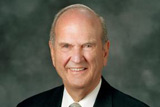
"One of this nation's leading pollsters, Richard Wirthlin, has identified through polls an expression of the basic needs of people in the United States. These needs are self-esteem, peace of mind, and personal contentment. I believe these are needs of God's children everywhere. How can these needs be satisfied? I suggest that behind each of these is the requirement to establish one's own personal identity as the offspring of God. All three needs, regardless of ethnic background, culture, or country, can be met if we look to the divinity that is within us." James E. Faust, "Heirs to the Kingdom of God," Ensign, May 1995
 I want to tell you something that I hope you will take in the right way: God is fully aware that you and I are not perfect.
Let me add: God is also fully aware that the people you think are perfect are not.
And yet we spend so much time and energy comparing ourselves to others—usually comparing our weaknesses to their strengths. This drives us to create expectations for ourselves that are impossible to meet. As a result, we never celebrate our good efforts because they seem to be less than what someone else does. Dieter F. Uchtdorf, Forget Me Not, October 2011 General Conference

The marvel of our physical bodies is often overlooked. Who has not encountered feelings of low self-esteem because of physique or appearance? Many people wish their bodies could be more to their liking. Some with naturally straight hair want it curly. Others with curly hair want it straight. Occasionally some ladies, believing that “gentlemen prefer blondes,” become “decided blondes.”
Your body, whatever its natural gifts, is a magnificent creation of God. It is a tabernacle of flesh—a temple for your spirit. A study of your body attests to its divine design." Elder Russell M. Nelson, You Are a Child of God, July 2008 New Era

Satan knows how to exploit and ensnare us with artificial substances and behaviors of temporary pleasure. I have observed the impact when one struggles to win back control, to become free from destructive abuse and addiction, and to regain self-esteem and independence. Elder M. Russell Ballard, O That Cunning Plan Of the Evil One, October 2010 General Conference
"Only as we accept the Atonement in our lives and strive to live the gospel can we meet the challenges of life and find peace, joy, and happiness. Coming to understand this great gift is an individual pursuit for each child of God. . . .
"If we could truly understand the Atonement of the Lord Jesus Christ, we would realize how precious is one son or daughter of God." Elder M. Russell Ballard, "The Atonement and the Value of One Soul," Ensign, May 2004
"If we could truly understand the Atonement of the Lord Jesus Christ, we would realize how precious is one son or daughter of God." Elder M. Russell Ballard, "The Atonement and the Value of One Soul," Ensign, May 2004
"When we remember that each of us is literally a spirit son or daughter of God, we will not find it difficult to approach our Heavenly Father in prayer. He appreciates the value of this raw material which we call life. 'Remember the worth of souls is great in the sight of God' (D&C 18:10). His pronouncement inspires purpose in our lives." President Thomas S. Monson, "The Master's Blueprint," Ensign, Jan. 2006
"Many of our challenges are different from those faced by former pioneers but perhaps just as dangerous and surely as significant to our own salvation and the salvation of those who follow us. For example, as for life-threatening obstacles, the wolves that prowled around pioneer settlements were no more dangerous to their children than the drug dealers or pornographers who threaten our children. Similarly, the early pioneers' physical hunger posed no greater threat to their well-being than the spiritual hunger experienced by many in our day. The children of earlier pioneers were required to do incredibly hard physical work to survive their environment. That was no greater challenge than many of our young people now face from the absence of hard work, which results in spiritually corrosive challenges to discipline, responsibility, and self-worth. Jesus taught: 'And fear not them which kill the body, but are not able to kill the soul: but rather fear him which is able to destroy both soul and body in hell' (Matt. 10:28)." Elder Dallin H. Oaks, "Following the Pioneers," Ensign, Nov. 1997
"There has come to you as your birthright something beautiful and sacred and divine. Never forget that. Your Eternal Father is the great Master of the universe. He rules over all, but He also will listen to your prayers as His daughter and hear you as you speak with Him. He will answer your prayers. He will not leave you alone." , "Stay on the High Road," Ensign, May 2004
Pride is a deadly cancer. It is a gateway sin that leads to a host of other human weaknesses. In fact, it could be said that every other sin is, in essence, a manifestation of pride.
This sin has many faces. It leads some to revel in their own perceived self-worth, accomplishments, talents, wealth, or position. They count these blessings as evidence of being “chosen,” “superior,” or “more righteous” than others. This is the sin of “Thank God I am more special than you.” At its core is the desire to be admired or envied. It is the sin of self-glorification. Dieter F. Uchtdorf, Pride and the Priesthood, October 2010 General Conference

I speak specifically of choices that have led to excessive debt and addictions to food, drugs, pornography, and other patterns of thought and action that diminish one’s sense of self-worth. All of these excesses affect us individually and undermine our family relationships. Of course some debt incurred for education, a modest home, or a basic automobile may be necessary to provide for a family. Unfortunately however, additional debt is incurred when we cannot control our wants and addictive impulses. And for both debt and addiction, the hopeful solution is the same—we must turn to the Lord and follow His commandments. Elder Robert D. Hales, Becoming Provident Providers Temporally and Spiritually, April 2009 General Conference
Let’s be honest; it’s rather easy to be busy. We all can think up a list of tasks that will overwhelm our schedules. Some might even think that their self-worth depends on the length of their to-do list. They flood the open spaces in their time with lists of meetings and minutia—even during times of stress and fatigue. Because they unnecessarily complicate their lives, they often feel increased frustration, diminished joy, and too little sense of meaning in their lives. Dieter F. Uchtdorf, Of Things That Matter Most, October 2010 General Conference